
Hola amigos de nortonteatro.blog. Yo soy Nortan Palacio, conocido artísticamente y en el Castillo de Lindabridis, como Norton P.
Hello friends of nortonteatro.blog. I am Nortan Palacio known artistically, and in the Castle of Lindabridis, as Norton P.
Viernes 23 febrero 2024.
ENGLIHS VERSION: BELOW SPANISH VERSION.
ANÉCDOTA 99
EL CASTILLO DE LINDABRIDIS: UN INEXPLORADO CALDERÓN DE LA BARCA.
Lector apreciado (si alguien es lector de este blog) si me sigues, te estarás preguntado al leer el título de la anécdota 99: “¿qué ha pasado aquí”, puesto que dos anécdotas atrás dije que en esta 99 iba a hablar de Francisco de Rojas Zorrilla, te pido mil disculpas pero es que la actualidad manda y en este caso también es una cuestión parabienes.
Parabienes porque pocas veces la Compañía Nacional de Teatro Clásico de España (aunque en coproducción con Nao d’amores) se atreve con obras, como El castillo de Lindabridis, que no pertenecen al canon. Una compañía Nacional, que no tiene problemas para llegar a fin de mes porque se financia con los impuestos de los españoles, debería dedicarse, al menos en alguna de sus vertientes, a mostrarnos también obras menos conocidas (y no por eso menos geniales) del muy rico repertorio del teatro del Siglo de Oro Español. Quizá esta vez Ana Zamora, directora de Nao d’amores[1] haya sido la que haya impuesto este criterio.
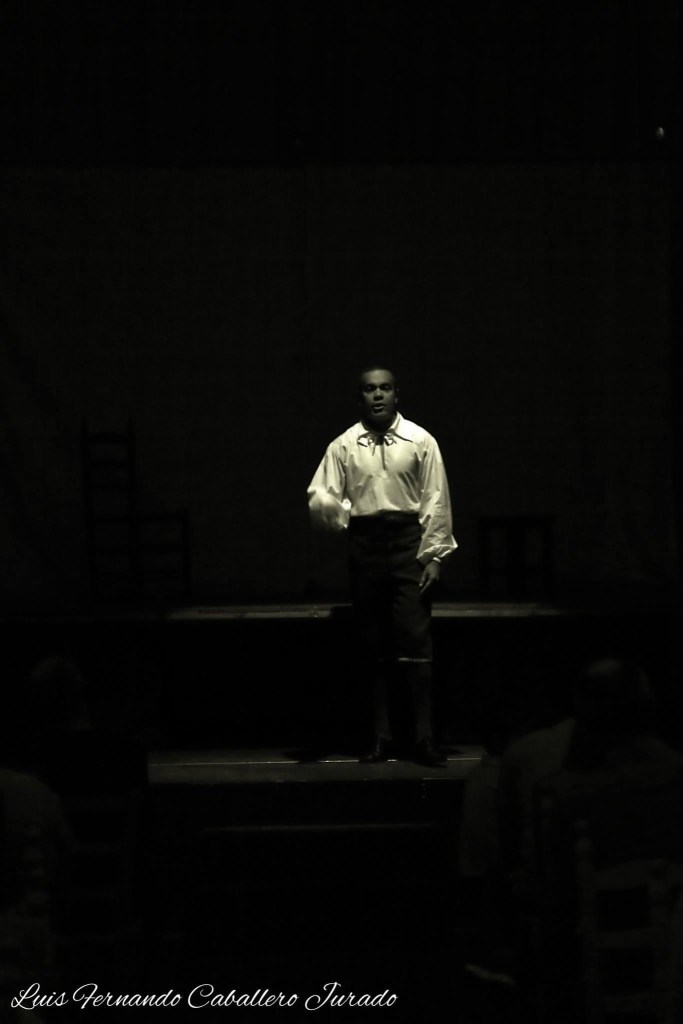
Por eso cuando pasé por Madrid la semana pasada me fui directamente a verla, y estando en la sala del Teatro de la Comedia me decidí a escribir mi próxima anécdota (es decir esta) sobre dicha obra. No acerca del montaje, puesto que este blog, tú ya lo sabes lector, no está dedicado a la crítica teatral, sino al chismorreo de las gentes que hacían teatro en el Siglo de Oro.
Por eso lo que te voy a decir de esta obra es cuándo y con qué fin se escribió, cuándo se representó por primera vez y en medio de qué periodo afectivo de la familia real, cuál era el estado anímico y social de Calderón, cuáles fueron las fuentes de las que bebió, qué tiene que ver su temática con todos estos asuntos y, finalmente, por qué no es una obra de las más conocidas; siendo, como es (pude comprobarlo escuchándola en la escena), de gran riqueza literaria.
Ya ves, chismes frescos de apenas cuatro siglos atrás.
Sin embargo, quiero decirte (me puede la actualidad) que es algo mágico que un espectáculo concebido por Calderón dentro del repertorio de sus comedias palaciegas de gran espectáculo: empezando porque el castillo mencionado vuela por los aires, lo hayan representado Ana Zamora y sus artistas en un teatro casi portátil y que aun así no haya perdido ni un ápice de su mensaje, de su magia y ni siquiera de su espectacularidad[2]. Pero, como dije, este no es un blog de crítica teatral, que para eso ya tenemos el recomendable blog del sabio José Luis González Subías: «La última bambalina»[3] quien la reseñó hace dos días.

Pues vamos a lo que me interesa: El castillo de Lindabridis es una comedia de Calderón de las que se han denominado comedias novelescas y en otros casos comedias caballerescas. La primera denominación se refiere a que está basada en una historia contada en una novela anterior (aunque la película es mejor que el libro), y la segunda a que la historia se desarrolla entre caballeros andantes medievales.
El libro en el que se basó Calderón se llamaba El espejo de príncipes y caballeros de Diego Ortúñez de Calahorra, y de entre esos el pasaje referido al caballero del Febo. Este libro fue de los pocos que aguantó y se siguió imprimiendo después del ostracismo al que condenó Cervantes con su don Quijote de la Mancha a los libros de caballerías: fue reimpreso hasta seis veces entre 1555 y 1617. De hecho, la historia del Caballero del Febo tuvo continuidad en libros como Guzmán de Alfarache, e incluso en la primera parte del Quijote; ya que Cervantes puso al Caballero del Febo como uno de los autores ficticios de los sonetos del prólogo de su obra (muestra de la genial sorna e ironía de Cervantes). Después de esto, El caballero del Febo pasó al teatro de la mano de Luis Vélez de Guevara en la obra El caballero del Sol de la que también bebió Calderón. Entonces era una historia no muy lejana a los contemporáneos de nuestro autor.
Pero claro, Calderón era mucho Calderón y tomo algunos materiales del original, los que creía que le convenían a su obra y a su cometido y por ejemplo, aunque el Casillo podía volar, desarrolló las escenas en pocos espacios: la cueva de un Fauno, Babilonia y una Ínsula Solitaria en Egipto. En cuanto a los descontrolados episodios del original, tomó como base uno de ellos cuando el Caballero del Febo conoce a dos hermanos gemelos: Lindabridis y Meridian y a partir de ahí desarrolló su historia:
Lindabridis no puede heredar el reino de Tartaria si no consigue a un caballero que venza a su hermano Meridian en un desafío, por eso vuela en su castillo en busca de guerreros y el primer lugar al que arriba es a la cueva de un Fauno (mitad humano y mitad bestia) que se enamora de la princesa solo con verla, pero causa pánico en ella. Sin embargo el Fauno se apunta al torneo. Después aparece otra princesa, Claridiana, que, vestida de hombre, va en busca del Caballero del Febo con quien está casada pero ha sido abandonada; Lindabridis al verla se prenda de ella y, creyéndola un caballero, la obliga a que también se apunte al torneo y sigue su camino. Entonces aparece en la playa un caballero casi muerto, que no es otro que Febo, que ha sido arrastrado después de un naufragio y quien le ayuda a recuperar el sentido es Claridiana, su mujer, pero que no desvela su género. Aun así, Febo se enamora del joven y femenil caballero. Vuelve Lindabridis que al ver a Febo también se enamora y, naturalmente, lo hace apuntar al torneo. Así van apareciendo otros caballeros que en el viaje del Castillo se van apuntando, entre ellos un hermano de Floridiana. Al final, el día del torneo en Babilonia, el Fauno los vence (que no los mata) a todos y creen que será el esposo de Lindabridis, pero llega el último caballero, que no es otro que Floridiana y vence al Fauno; por lo que Lindabridis le ofrece su mano; así que Floridiana tiene que revelar su identidad y su estado con lo que le da a Lindabridis la mano de su hermano y se reconcilia con Febo.
Parecería que son muchos lances y amoríos, pero te digo que si lo comparamos con los lances originales son realmente pírricos. Además calderón adereza los cambios de actos con danzas ceremoniales y populares, que hacen que se pasen los enredos de manera sobria y no cansen. El estilo de la obra puede considerarse como de cuento de hadas, pero hábilmente aderezado con el poder de los personajes femeninos: Lindabridis vuela en busca de su destino y es la propia conductora de su nave voladora y Floridiana es la única, siendo mujer, capaz vencer al Fauno. No es de extrañar esta condición que otorga Calderón a los papeles femeninos teniendo en cuenta sus «reales» receptores.
Y digo «reales» porque en realidad Calderón escribió e hizo representar esta obra por los carnavales de 1661, en el palacio del Buen retiro, para consolar a la princesa Margarita que se había quedado sola, después de la boda de su hermana María Teresa con Luis XIV de Francia unos meses antes. De ahí que los personajes de las mujeres fuertes estén significando a las dos hermanas que debían ser fuertes luego de su separación.
En los años en que escribió esta obra, ya Calderón apenas escribía para los teatros comerciales, solamente Autos Sacramentales. Y si escribía estas obras espectaculares era por petición expresa de los reyes, a través de su mecenas: Don Gaspar de Haro y Guzmán, Marqués de Eliche. De hecho en esa misma época escribió otras dos: La púrpura de la Rosa, que fue escrita para el cumpleaños del príncipe Felipe Prospero a principios de 1660, pero que como los actores no aprendieron el texto a tiempo, hubo que reprogramarla para la boda de María Teresa con Luis XIV en diciembre del mismo año, y Eco y Narciso que se representó para la celebración del cumpleaños de Margarita el 12 de julio de 1661. Algunos investigadores consideran estas tres obras como una trilogía que debido a que iban dedicadas a los jóvenes príncipes estaban dotadas de: «extraordinaria delicadeza y con miras a un auditorio juvenil[4]»
Cuál puede ser la causa de que estas obras no hayan sido más valoradas en su andadura histórica; Juan Manuel Escudero Baztán cree que los estudiosos muestran un palpable desinterés por este tipo de obras seguramente derivado de los desfavorables comentarios que escribió don Marcelino Menéndez Pelayo en su libro Calderón y su Teatro en el que señalaba que las comedias caballerescas de Calderón eran fundamentalmente defectuosas porque:
Los dramas fundados en libros de caballería tienen el mismo defecto esencialmente que las comedias mitológicas, con más el pecado capital de estar tomadas de novelas que rara vez son a propósito para las tablas. Una porción de recursos que son verosímiles en las novelas, no son tolerables en una representación escénica que se ve y no se lee, y en la cual, por consiguiente, no caben las inverosimilitudes que se admiten en la novela.
Es lo que tenía ser el «pope» de la investigación del Teatro del Siglo de Oro a principios del siglo XX, que todos tenían que seguir tus dictados. Sin embargo yo estoy seguro de que si Menéndez Pelayo viese el montaje de Nao d’amores y la Compañía Nacional de teatro Clásico se vería tentado a borrar este párrafo de su libro.
Si has llegado hasta aquí, lector amigo, te emplazo para otra anécdota (no te voy a decir cuál, no sea que yo cambie de opinión) la próxima semana.
[1] Esta compañía se dedica más que nada al teatro renacentista y algunas veces medieval. Y aunque El castillo de Lindabridis no pudo haber sido escrita por un autor más Barroco que Calderón de la Barca, sus aventuras discurren en escenarios maravillosos, legendarios, medievales y mágicos que caben en el imaginario de Nao d’amores.
[2] Lo que confirma la teoría de que toda la literatura dramática puede representarse en la escena de miles de maneras. Mientras no pierda su significancia.
[3] A quien no lo conozca, y quiera enterarse de todo lo que se representa en los teatros de Madrid y cómo es de recomendable, valga la redundancia, se lo recomiendo
[4] Así al menos las describe Ángel Valbuena Briones.
ANECDOTE 99
THE CASTLE OF LINDABRIDIS: AN UNEXPLORED CALDERÓN DE LA BARCA.
Dear reader (if anyone is a reader of this blog) if you follow me, you may be wondering when you read the title of anecdote 99: «what has happened here», since two anecdotes ago I said that in this 99 I was going to talk about Francisco de Rojas Zorrilla, I apologize a thousand times but the fact is that current events rule and in this case it is also a question of goodwill.
It is a good thing because the Spanish National Classical Theatre Company (although in co-production with Nao d’amores Company) rarely dares to do works, such as The Castell of Lindabridis, which do not belong to the canon. A national company, which has no problem making ends meet because it is financed by the taxes of the Spanish people, should dedicate itself, at least in some of its aspects, to also showing us lesser-known (and no less brilliant) works from the very rich repertoire of the theatre of the Spanish Golden Age. Perhaps this time Ana Zamora, director of Nao d’amores,[1] has been the one who has imposed this criterion.
That’s why when I passed through Madrid last week I went straight to see it, and being in the stalls of the Teatro de la Comedia I decided to write my next anecdote (that is, this one) about that play. Not about staging, since this blog, as you already know reader, is not dedicated to theatre criticism, but to the gossip of the people who made theatre in the Golden Age.
That is why what I am going to tell you about this play is when and for what purpose it was written, when it was performed for the first time and in the middle of what affective period of the royal family, what was Calderón’s mood and social state, what were the sources from which he drank, what does its theme have to do with all these matters and, finally, why it is not one of the best-known works; being, as it is (I could see it by listening to it on the scene), of great literary richness.
You see: fresh gossip from just four centuries ago.
However, I want to tell you that it is something magical that a show conceived by Calderón within the repertoire of his palace comedies of great spectacle: starting with the fact that the aforementioned castle flies through the air, has been represented by Ana Zamora and her artists in an almost portable theater and that even so it has not lost an iota of its message, of its magic and not even of its spectacularity[2]. But, as I said, this is not a blog of theater criticism, for that we already have the recommended blog of the wise José Luis González Subías: «La última bambalina«[3] who reviewed it two days ago.
Well, let’s get to what interests me: The Castle of Lindabridis is a comedy by Calderón of those that have been called «novel comedies» and in other cases «chivalric comedies». The first name refers to the fact that it is based on a story told in an earlier novel (although the film is better than the book), and the second to the fact that the story takes place among medieval knights-errant.
The book on which Calderón was based was called The Mirror of Princes and Knights by Diego Ortúñez de Calahorra, and among those the passage referring to the knight of Phoebus. This book was one of the few that endured and continued to be printed after the ostracism to which Cervantes condemned the books of chivalry with his Don Quixote of La Mancha: The mirror of Princes and Knights was reprinted up to six times between 1555 and 1617. In fact, the story of the Knight of Phoebus was continued in books such as Guzmán de Alfarache, and even in the first part of Don Quixote; since Cervantes put the Knight of Phoebus as one of the fictitious authors of the sonnets of the prologue of his work (an example of Cervantes’ brilliant sarcasm and irony). After this, El caballero del Febo went to the theater by the hand of Luis Vélez de Guevara in the play El caballero del Sol from which Calderón also took ideas. At that time, it was a story not far removed from our author’s contemporaries.
But of course, Calderón was very high author and took some materials from the original, those that he believed suited his work and his mission and, for example, although Casillo could fly, he developed the scenes in a few spaces: the cave of a Faun, Babylon, and a Lonely Island in Egypt. As for the out-of-control episodes of the original, I take one of them as a basis when the Knight of Phoebus meets two twin brothers: Lindabridis and Meridian and from there he developed his story:
Lindabridis can’t inherit the kingdom of Tartary if she doesn’t get a knight to beat his brother Meridian in a challenge, that’s why he flies in his castle in search of warriors and the first place he arrives is the cave of a Faun (half human, and half beast) who falls in love with the princess just by seeing her, But it causes panic in her. However, the Faun sappply for the tournament. Then another princess appears, Claridiana, who, dressed as a man, goes in search of the Knight of Phoebus to whom she is married but has been abandoned; Lindabridis, upon seeing her, falls in love with her and, believing her to be a gentleman, forces her to apply for the tournament as well and continues on her way. Then a knight almost dead appears on the beach, who is none other than Phoebus, who has been dragged after a shipwreck and who helps him to recover his senses is Claridiana, his wife, but who does not reveal her gender. Still, Phoebus falls in love with the young, feminine knight. Lindabridis returns, and when he sees Phoebus, he also falls in love and, naturally, makes him apply for the tournament. In this way, other knights appear who also apply on the journey to the Castle, among them a brother of Floridiana. In the end, on the day of the tournament in Babylon, the Faun defeats them all and they believe that he will be Lindabridis’ husband, but the last knight arrives, who is none other than Floridiana and defeats the Faun; so Lindabridis offers him his hand; so Floridiana has to reveal her identity and her status by giving Lindabridis her brother’s hand and reconciling with Phoebus.
It would seem that there are many problems and love affairs, but I tell you that if we compare it with the original problems they are really poor. In addition, Calderón spices up the changes of different acts with ceremonial and popular dances, which make the entanglements go through in a sober way and do not get bored. The style of the work can be considered as faitytale, but skilfully seasoned with the power of female characters: Lindabridis flies in search of her destiny and is the driver of her flying ship and Floridiana is the only one, being a woman, capable of defeating the Faun. It is not surprising that Calderón gives this status to female roles, taking into account their «real» recipients.
And I say «real: royal» because in reality Calderón wrote and had this play performed for the carnival of 1661, in the Buen Retiro Palace, to console Princess Margaret who had been left alone, after the wedding of her sister Maria Theresa to Louis XIV of France a few months earlier. Hence, the characters of the strong women are signifying the two sisters who were supposed to be strong after their separation.
In the years in which he wrote this play, Calderón was already writing only Autos Sacramentales for commercial theaters. And if he wrote these spectacular works, it was at the express request of the kings, through his patron: Don Gaspar de Haro y Guzmán, Marquis of Eliche. In fact, at the same time he wrote two others: The Purple of the Rose, which was written for the birthday of Prince Philip Prospero in early 1660, but as the actors did not learn the text in time, it had to be rescheduled for the wedding of Maria Theresa to Louis XIV in December of the same year, and Echo and Narcissus which was performed for the celebration of Margaret’s birthday on 12 July 1661. Some scholars consider these three works as a trilogy that, because they were dedicated to young princes, were endowed with: «extraordinary delicacy and with a view to a youthful audience[4]«
What could be the reason why these works have not been more valued in their historical career; Juan Manuel Escudero Baztán believes that scholars show a palpable lack of interest in this type of work, probably derived from the unfavorable comments written by Marcelino Menéndez Pelayo in his book Calderón y su Teatro in which he pointed out that Calderón’s chivalric comedies were fundamentally defective because:
Dramas founded on books of chivalry have essentially the same defect as mythological comedies, with the cardinal sin of being taken from novels that are seldom fit for the stage. A portion of resources that are plausible in novels are not tolerable in a stage performance that is seen and not read, and in which, therefore, there is no room for the implausibilities that are admitted in the novel.
That’s what it was like to be the «pope» of Golden Age Theatre research at the beginning of the 20th century, that everyone had to follow your dictates. However, I am sure that if Menéndez Pelayo saw the staging of Nao d’amores and the Compañía Nacional de Teatro Clásico, he would be tempted to delete this paragraph from his book.
If you’ve made it this far, dear reader, I’ll call you for another anecdote (I’m not going to tell you which one, lest I change my mind) next week.
[1] This company is mostly dedicated to Renaissance and sometimes medieval theater. And although The Castle of Lindabridis could not have been written by a more Baroque author than Calderón de la Barca, its adventures take place in wonderful, legendary, medieval and magical settings that fit into the imaginary of Nao d’amores.
[2] This confirms the theory that all dramatic literature can be represented on the stage in a thousand ways. As long as it doesn’t lose its significance.
[3] To those who don’t know it, and want to find out about everything that is represented in the theaters of Madrid and how it is recommended, I recommend it
[4] At least that’s how Ángel Valbuena Briones describes them.


Muchas gracias por este maravilloso descubrimiento Norton!
No había oído hablar de esta obra, intentaré ir a verla antes del 10 de marzo, debe ser una maravilla!
Me gustaMe gusta
Espero que os guste tanto como a mí y que estos datos que aporto os enriquezcan la degustación de la obra.
Me gustaMe gusta