
Hola amigos de nortonteatro.blog. Yo soy Nortan Palacio, conocido artísticamente y entre las muñecas de Marcela, como Norton P.
Hello friends of nortontearo.blog. I am Nortan palacio, known artistically, and between the marcela dolls, as Norton P.
Viernes 20 enero 2024.
ENGLISH VERSION: BELOW SPANISH VERSION
ANÉCDOTA 94
LOS DRAMATURGOS SEGUNDONES EN EL SIGLO DE ORO ESPAÑOL:
ÁLVARO CUBILLO DE ARAGÓN II
Mi querido lector, discúlpame pues la vuelta a las entradas del Mentidero de los Comediantes en este 2024 se me estaban haciendo cuesta arriba. Ya sabes, los nuevos ciclos traen nuevos objetivos, nuevas colecciones, nuevas promesas de vida sana, etc. Y nos olvidamos de las cosas que están siempre ahí y que nos hacen disfrutar tanto o más que las esperanzadoras novedades del año que empieza. Así que, después de hacerme a la idea de que no voy a realizar todos los nuevos planes, vuelvo a mi blog, y con muchas ganas.
En la última entrada te había hablado de otro de los dramaturgos de la serie de los (mal llamados) segundones. Se trata de Álvaro Cubillo de Aragón de quien repasamos su experiencia vital, pero se nos había quedado en la papelera el repaso al estilo de su escritura teatral y a sus obras más importantes y es de lo que en esta anécdota te vengo a hablar. Pero antes, a manera de repaso, veremos los datos mas importantes de su biografía:
Te recuerdo que era un autor del que se tenían muy pocas noticias y algunas de las que se tenían eran falsas, hasta que hace bastante poco se han ido revelando más detalles, por la labor de investigadores como Francisco Rodríguez Matito y Otero Mondéjar y gracias a ellos ahora se sabe que se crio en Granada y que vivió en Sevilla antes de trasladarse definitivamente a Madrid a intentar triunfar como dramaturgo; y en su momento triunfó en los Corrales de Comedias que se abarrotaban para ver sus nuevas obras. Sabemos que llegó a escribir más de cien comedias[1], algunas de mucho éxito que despertaban envidia y admiración entre sus contemporáneos (he de decir que, sorprendentemente, Lope de Vega, a pesar de que Cubillo de Aragón triunfaba igual que él, nunca le tomó inquina y lo alababa). Lo que pasa es que como llegó a tener once hijos, siempre vivió en la pobreza y medrando por entre los mecenas. Finalmente murió pobre y a las puertas del olvido en Madrid el 21 de octubre de 1661.
De su vida, lo que más resaltábamos en la anécdota anterior fue que en el año 2019 se había descubierto, por una fortuita casualidad[2], su lugar y fecha de nacimiento y que había sido en Almagro, y no en Granada como se creía; en 1590 y no en 1596 como se decía.
Ahora sí, paso a revisar su obra dramática que es lo que nos interesa: hay que decir que de las más de cien obras que el mismo dijo que había escrito se conservan unas treinta y cinco. También es notorio que su estilo fue variando con el tiempo: empezó siguiendo la famosa fórmula de la Comedia Nueva instaurada por Lope de Vega y terminó adherido al círculo de seguidores de Calderón de la Barca, por lo que se considera que su obra es una práctica herramienta de estudio, para conocer cómo evolucionó el teatro en el famoso Siglo de Oro Español.
Sin embargo, Cubillo de Aragón se diferencia de ambos genios en algunas cosas particulares como la observación de los detalles más insignificantes y que parecieran menos importantes de la vida cotidiana, para crear sus comedias de costumbres (el subgénero en el que más destacó). Y aunque muchas veces tomó temas prestados de los dos maestros se puede comprobar que mejoraba las comedias que imitaba. No te quiero decir que mejorase las obras maestras de estos dos tan grandes genios, sino que, inteligentemente, tomaba obras que Lope y Calderón no habían dejado bien acabadas y que eran objeto de mejora.
Se puede apreciar en las obras de Cubillo de Aragón, que para acercarse al estilo de Calderón tuvo que valerse de recursos poéticos del conceptismo y el culteranismo (que, como sabrás, dificultan el entendimiento de la poesía entre los espectadores o lectores no iniciados), pero a diferencia de Calderón, que se valía de estos recursos para crear muchos de sus mejores dramas ya que allí cabían de forma natural, Cubillo de Aragón supo usarlos para crear sus comedias de costumbres, de manera que aunque un espectador no versado no entendiese el concepto, sí entendía el contexto y así, nuestro autor, era capaz de divertir a todos (necios y sabios). De ahí que en su momento, como dije, fuera considerado uno de los grandes entre los grandes (Lope-Tirso-Calderón).
Entre sus obras más conocidas destacan de las comedias: Añasco el de Talavera, La perfecta casada, El señor de Noches Buenas[3], El invisible príncipe del baúl (un título bastante novedoso para una obra teatral en ese momento en España); de temas históricos tanto nacionales como universales tenemos: Elisa Dido, reina de Cartago, Hechos de Bernardo del Carpio, El genízaro de España, El conde de Saldaña; de temas religiosos son interesantes: El bandolero de Flandes, El mejor rey del mundo y templo de Salomón, El justo Lot; también escribió Autos Sacramentales como: El hereje[4], Nuestra señora del Rosario: ciento por uno, etc.
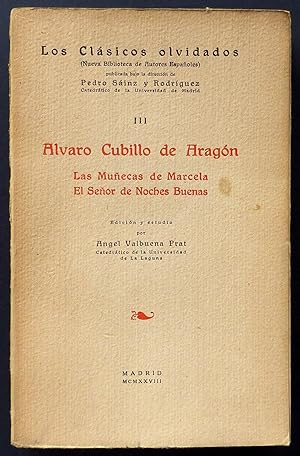
De entre todas ellas destaca la que es considerada su obra maestra y una de las mejores de todo el repertorio del Siglo de Oro es la titulada Las muñecas de Marcela, que es una comedia donde nos presenta una defensa de la tolerancia para con las personas diferentes (novedad también, entonces y ahora) a través de un conflicto generacional donde muestra a unos viejos conservadores e inflexibles frente a unos jóvenes que toleran y saben perdonar. Marcela, una muchacha que es capaz de esconder a un fugitivo de la justicia en su cuarto de muñecas, donde jugaba de niña. Allí lo alimenta y entre tanto surge el amor. El argumento no sería novedoso (hay muchos casos de escondidos por las damas en sus casas en las comedias de Siglo de Oro: como paradigma: La dama duende de Calderón de la Barca) si no es porque el escondido es un fugitivo y Marcela es la única que cree en su inocencia.
Pero no quería acabar sin mencionar una comedia más de Cubillo de Aragón que descubrí por sorpresa, gracias a un amigo que me la presentó. La comedia es El amor cómo ha de ser, que no es de las más nombradas y sin embargo, gracias a la terquedad de Fernando Gómez Cabia, el amigo al que menciono, quien hizo una particular edición de esta obra descubrimos que además de ser una obra en la que Cubillo, como en el título indica; critica que en las comedias por lo regular se muestran amores insulsos, platónicos e increíbles, y se decanta por el amor desgarrador, imposible, aunque real; también es una de las primeras obras del Barroco Español donde se muestra en escena una relación amorosa entre personas del mismo sexo.
Así, querido lector, esperando que con la curiosidad por conocer alguna obra de Cubillo de Aragón quede en tu haber, me despido emplazándote para conocer a otro sorprendente dramaturgo segundón en la próxima entrada del Mentidero de los Comediantes.
[1] Él mismo lo dejó sentado en el “Prólogo al lector” de su obra miscelánea El enano de las Musas, donde combina poesía con prosa y teatro (allí se encuentran doce de sus más conocidas comedias)
[2] Ver la anécdota 93 de este blog.
[3] Donde se encuentra una situación muy similar a la de Cyrano de Bergerac de Edmond Rostand, estrenada en 1897, por lo que se cree que Rostand pudo haber conocido la obra de Cubillo de Aragón
[4] Es una obra que se daba por perdida y ha sido encontrada y editada en 2008. Con lo que la esperanza de aumentar el numero de obras de Cubillo sigue teniendo validez
ANECDOTE 94
SECONDED PLAYWRIGHTS IN THE SPANISH GOLDEN AGE:
ÁLVARO CUBILLO DE ARAGÓN II
My dear reader, excuse me because the return to the entries of the Mentidero de los Comediantes in this 2024 was making an uphill struggle for me. You know, new cycles bring new goals, new collections, new promises of healthy living, etc. And we forget about the things that are always there and that make us enjoy as much or more than the hopeful news of the year that begins. So, after getting used to the idea that I’m not going to make all the new plans, I’m back to my blog, and with a lot of enthusiasm.
In the last post I had told you about another of the playwrights of the series of the (misnamed) seconded. This is Álvaro Cubillo de Aragón of whom we reviewed his life experience, but the review of the style of his theatrical writing and his most important works had been left in the wastebasket and that is what I come to talk about in this anecdote. But first, by way of review, let’s look at the most important facts of his biography:
I remind you that he was an author of whom there was very little news and some of what was known was false, until quite recently when more details have been revealed, due to the work of researchers such as Francisco Rodríguez Matito and Otero Mondéjar and thanks to them it is now known that he grew up in Granada and lived in Seville before moving permanently to Madrid to try to succeed as a playwright; and in that moment he triumphed in the Corrales de Comedias that were packed to see his new works. We know that he wrote more than a hundred comedies[1], some of them very successful that aroused envy and admiration among his contemporaries (I have to say that, surprisingly, Lope de Vega, despite the fact that Cubillo de Aragón triumphed just like him, never took a grudge against him and praised him). The thing is that since he had eleven children, he always lived in poverty and thrived among the patrons. He finally died poor and on the verge of oblivion in Madrid on October 21, 1661.
Of his life, what we highlighted most in the previous anecdote was that in 2019 his place and date of birth had been discovered, by a fortuitous coincidence[2], and that it had been in Almagro, and not in Granada as was believed; in 1590 and not in 1596 as it was said.
Now, I will review his dramatic work, which is what interests us: it must be said that of the more than one hundred plays that he himself said he had written, about thirty-five have been preserved. It is also notorious that his style varied over time: he began following the famous formula of the New Comedy established by Lope de Vega and ended up adhering to the circle of followers of Calderón de la Barca, so it is considered that his works are practical tool of study, to know how theater evolved in the famous Spanish Golden Age.
However, Cubillo de Aragón differs from both geniuses in some particular things, such as the observation of the most insignificant and seemingly less important details of everyday life, to create his comedies of manners (the subgenre in which he stood out the most). And although he often borrowed themes from the two masters, it can be seen that he improved on the comedies he imitated. I don’t want to tell you that he improved the masterpieces of these two great geniuses, but that he intelligently took works that Lope and Calderón had not left well finished and that were the object of improvement.
This can be seen in the works of Cubillo de Aragón, who in order to approach Calderón’s style had to make use of poetic resources of conceptism and culteranism (which, as you may know, make it difficult for uninitiated spectators or readers to understand poetry), but unlike Calderón, who used these resources to create many of his best dramas since they fit there naturally, Cubillo de Aragón knew how to use them to create his comedies of manners, so that even if an unversed spectator did not understand the concept, he did understand the context and thus, our author, was able to amuse everyone (fools and wise). Hence, at that time, as I said, he was considered one of the greats of the great (Lope-Tirso-Calderón).
Among his best-known works are comedies: Añasco el de Talavera, La perfecta casada, El señor de Noches Buenas, El invisible príncipe del baúl (a rather novel title for a theatrical play at that time in Spain); of both national and universal historical themes we have:[3] Elisa Dido, queen of Carthage, Acts of Bernardo del Carpio, The Genízar of Spain, The Count of Saldaña; from religious themes are interesting: The Bandit of Flanders, The Best King in the World and Temple of Solomon, The Righteous Lot; He also wrote Autos Sacramentales such as: The Heretic[4], Our Lady of the Rosary: One Hundred by One, etc.
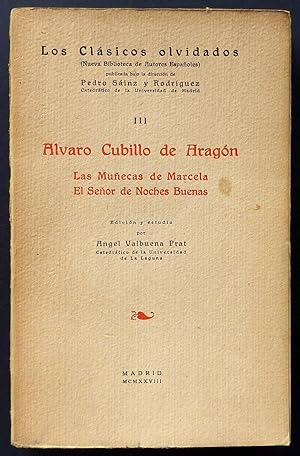
Among all of them, the one that is considered his masterpiece and one of the best in the entire repertoire of the Golden Age stands out is the one entitled Las muñecas de Marcela, which is a comedy where he presents us with a defense of tolerance towards different people (also a novelty, then and now) through a generational conflict where he shows some conservative and inflexible old people against young people who tolerate and they know how to forgive. Marcela, a girl who is able to hide a fugitive from justice in her doll room, where she played as a child. There she feeds him and in the meantime love arises. The plot would not be new (there are many cases of the ladies hiding in their homes in the comedies of the Golden Age: as a paradigm: La dama duende by Calderón de la Barca) if it were not for the fact that the person in hiding is a fugitive and Marcela is the only one who believes in his innocence.
But I didn’t want to end without mentioning one more comedy by Cubillo de Aragón that I discovered by surprise, thanks to a friend who introduced it to me. The comedy is El amor cómo ha de ser, which is not one of the most famous and yet, thanks to the stubbornness of Fernando Gómez Cabia, the friend I mention, who made a particular edition of this work, we discover that in addition to being a work in which Cubillo, as the title indicates; criticizes the fact that comedies usually show insipid loves, platonic and incredible, and he opts for heartbreaking, impossible, yet real love; it is also one of the first works of the Spanish Baroque where a love relationship between people of the same sex is shown on stage.
So, dear reader, hoping that with the curiosity to know some of Cubillo de Aragón’s works will remain to your credit, I say goodbye by summoning you to meet another surprising second playwright in the next entry of the Mentidero de los Comediantes.
[1] He himself stated this in the «Prologue to the Reader» of his miscellaneous work El enano de la Musas (The Dwarf of the Muses), where he combines poetry with prose and theatre (twelve of his best-known comedies can be found there)
[2] See anécdota 93 of this blog.
[3] There is a situation very similar to that of Edmond Rostand’s Cyrano de Bergerac, premiered in 1897, so it is believed that Rostand may have known the work of Cubillo de Aragón
[4] It is a work that was thought to be lost and has been found and published in 2008. So the hope of increasing the number of Cubillo’s works is still valid
 Norton Teatro
Que bien Norton , por ampliar el conocimiento de profanos como yo en el tema que tú de manera sencilla y eminentemente lúdica manejas y compartes . Pregunta : se representan las obras de Avaro Cubillo de Aragón? y porque crees que cayó en el olvido?
Me gustaMe gusta
Mi querido Hugo, gracias por tus palabras amables y animosas. Pues a Cubillo de Aragón se le representa poco, me atrevería a decir que casi nada. El motivo de su olvido puede ser el que sufrieron muchos de esos autores segundones: que no se preocuparon en vida por editar sus obras y así solo se conservaron manuscritos difíciles de rastrear. Cuando los románticos alemanes en el siglo XIX redescubrieron el Barroco Español, lo hicieron con las obras editadas por Lope/Tirso/Calderón
Me gustaMe gusta