
Hola amigos de nortonteatro.blog. Yo soy Nortan Palacio, conocido artísticamente y en la compañía de Angulo el malo, como Norton P.
ANÉCDOTA 81
EL MENTIDERO DE LOS COMEDIANTES: EL DÍA DEL CORPUS CHRISTI. CELEBRACIÓN CLAVE EN EL DESARROLLO DEL TEATRO DEL SIGLO DE ORO ESPAÑOL. ¿POR QUÉ? II
Pues en la anécdota pasada veíamos cómo se había institucionalizado la fiesta del Corpus en el mundo cristiano y nos habíamos quedado en que los religiosos españoles, abanderados de la Contrarreforma, se habían dado cuenta de que el teatro no solo servía para entretener, divertir o hacer llorar sino que tenía un componente doctrinario[1] propio en este caso, para la catequización de los, en su mayoría analfabetos, españoles más pobres.
Entonces los religiosos, que sabían que existían unas piezas teatrales llamadas «Autos» (todavía no se conocían como Sacramentales sino que podían estar dedicados a cualquier fiesta eclesiástica: Natividad, la Pasión, La venida de los Reyes Magos, etc.) empiezan a pedir ayuda ‒económica‒ a los ayuntamientos para que se escribieran Autos dedicados a la exaltación de la Eucaristía y se representaran con pompa y boato en el día del Corpus, después de las procesiones.
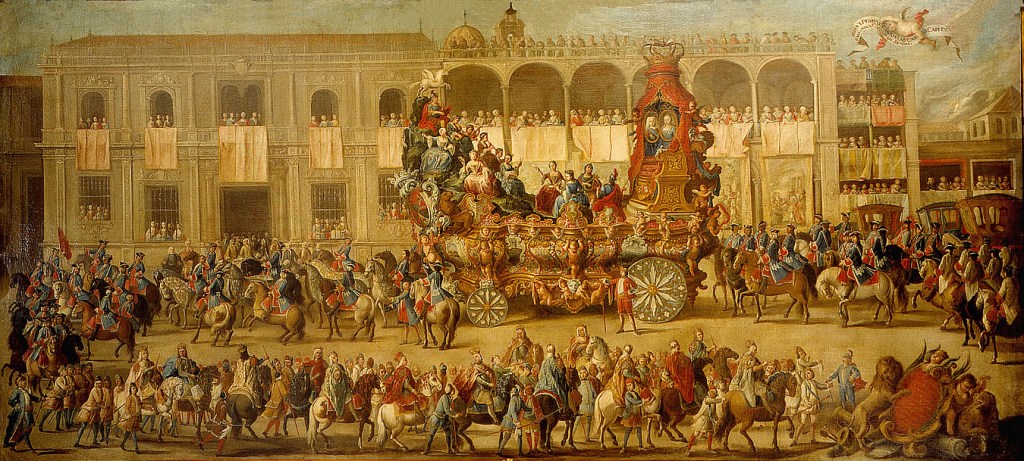
Por la edición de un libro que recogió y fechó los Autos más antiguos de aquella España, se cree que empezarían a representarse entre 1550 y 1570. De las 96 piezas recogidas en este libro titulado: Colección de autos farsas y coloquios del siglo XVI[2](pero que se conoce como Códice de Autos Viejos) se encuentran más de treinta con temática del Sacramento de la Eucaristía, por lo que podrían haberse escrito para las fiestas del Corpus.
El éxito debió de ser importante porque además hay que añadir que el Auto, la pieza más religiosa y difícil de entender, era corto: un acto que no debía tener más de 1000 versos (las comedias normales tenían más de 3000). Además iba acompañada de loas, entremeses, jácaras, mojigangas y un desfile de tarascas, es decir que se mezclaba lo religioso con lo profano para no cansar al vulgo.
Tanto éxito debió tener, que los Ayuntamientos en busca de mayor lucidez y prestigio (algo similar a lo que pasa ahora con el alumbrado navideño) decidieron invertir más y, claro, el dinero atrajo la atención de las compañías más importantes (compañías de título) y de los autores más cotizados, con, no podría ser de otra forma, Lope de Vega a la cabeza. En 1604 se representó en la fiesta del Corpus de Sevilla uno de los Autos de El Peregrino en su Patria que es el que se considera el más antiguo de quien se tiene fecha y documentación de contratos.
Luego de esto, casi todos los autores reputados escribieron Autos Sacramentales, destacando José de Valdivieso, Mira de Amescua, Tirso de Molina, pero quien lo llevó a la cumbre de la perfección fue Calderón de la Barca, quien estrenó el primero en 1634 en Madrid y siguió cosechando este género hasta el día de su muerte en 1680.
Pero hablar de esto sería otro tema, puesto que lo que queremos hacer notar es como este día se hizo tan importante para el mundo teatral en aquella España.
Primero hay que decir que como las compañías no dependían de las entradas de ese día para su recaudación, sino que los mismos ayuntamientos los contrataban y con buenos beneficios económicos, entonces usaban ese dinero extra para rehacerse: se renovaban los vestuarios nuevos, cada vez más ricos ‒lo bueno era que como los autores usaban personajes que podrían ser arquetipos de la comedia: Dios era un Galán, El Alma era una Dama, el Diablo podría ser un criado cómico, etc., el vestuario realizado para tal fecha tenía recorrido en las comedias de todo el año‒
También es destacable que debido a que durante la Cuaresma estaba prohibido representar, los empresarios aprovechaban para contratar nuevos y más famosos actores (eran los fichajes de Cuaresma), con la promesa de que con el dinero del Corpus se les pagaría los añadidos, «cláusulas» que los contratos de estos famosos actores requerían.
Lo único era que esto sólo conllevaba una representación para todo el año, por lo que había que buscarse triquiñuelas para ganar más. Por ejemplo, en principio solo se representaba un Auto por la tarde, pero después, queriendo destacar, en Toledo se empezaron a representar dos; uno por la mañana en mitad de la procesión y otro por la tarde y los demás ayuntamientos no tardaron en seguir esta dinámica. Aunque los ayuntamientos prohibían que los actores de la mañana fueran los mismos de por la tarde, para evitar que el que por la mañana representaba a Dios quizá por la tarde fuera el Placer o el Demonio, o la Virgen de la Mañana, fuera la Culpa de por la tarde, y confundiera a los espectadores más ingenuos.
Así que contrataban dos compañías diferentes, pero hechas las leyes hechas las trampas, este escollo lo salvaban de diferentes maneras: algunas veces, como las compañías estaban formadas por entre quince y veinte actores, el empresario le pedía al dramaturgo que escribiera Autos con ocho personajes y así la mitad de la compañía representaba por la mañana y la mitad por la tarde. Hay un caso documentado con Lope de Vega que escribió dos Autos con pocos actores para que los representara el mismo día la compañía del empresario Antonio de Riquelme, en el Corpus de Madrid de 1615.
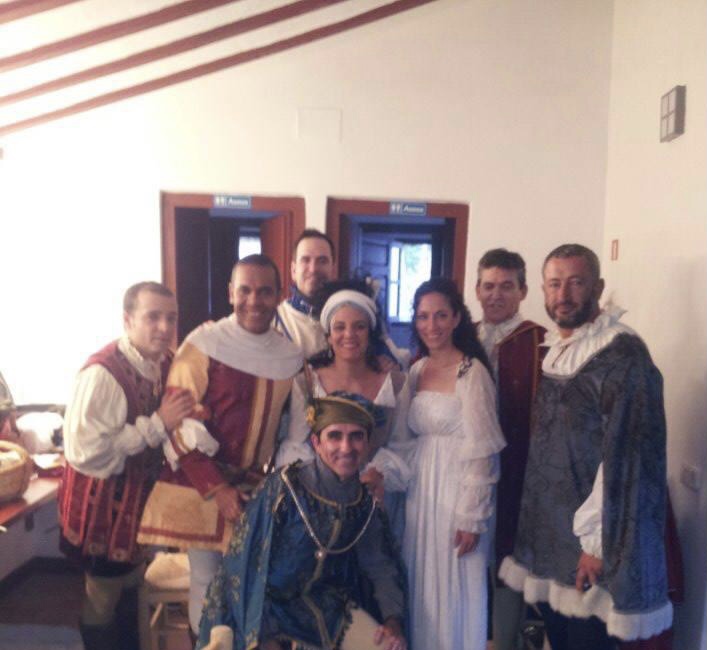
O también se ponían de acuerdo dos compañías para representar por la mañana en un sitio y por la tarde en otro, que fueran sitios cercanos, y así no perder un segundo contrato. Esto lo ejemplifica muy bien Cervantes en el Quijote, cuando el Hidalgo y Sancho encuentran el carro del Autor Angulo el Malo y los actores van vestidos como los personajes (el Demonio, un Ángel, una Reina, el Dios Cupido, etc.) por lo que Don Quijote, creyendo que son realmente los seres de que van vestidos, los interpela. Pero después los deja ir porque, el «Demonio» le explica que para no perder tiempo, habiendo terminado de representar un Auto en un pueblo van hacia otro en el que empezarán sin tener que cambiarse:
Señor, nosotros somos recitantes de la compañía de Angulo el Malo. Hemos hecho en un lugar que está detrás de aquella loma, esta mañana, que es la octava del Corpus, el auto de Las Cortes de la Muerte, y hémosle de hacer esta tarde en aquel lugar que desde aquí se parece; y por estar tan cerca y escusar el trabajo de desnudarnos y volvernos a vestir, nos vamos vestidos con los mesmos vestidos que representamos[3].
Finalmente, como bien dice el Demonio a Don Quijote, también empezó a celebrarse la Octava del Corpus, el jueves siguiente al día de la fiesta oficial y claro, esto también conllevó otros dos Autos en todos los sitios. Grande ciudades, villas, pueblos y puebluchos celebraban sus Corpus ahora con cuatro Autos.
Porque los contratos eran económicamente buenos, porque podían rehacer los vestuarios, porque podían contratar actores con más fama para toda la siguiente temporada, porque podían hacer caja con cuatro autos en lugar de uno, porque podían contratar a mejores dramaturgos (que también hacían que el género fuese de más calidad); por todas estas razones: las compañías de teatro, todas, todas, incluso las más pobres como las Compañías de La Legua, esperaban el día del Corpus como agua de mayo y ese día, casi que determinaba el resto de la temporada.
Querido lector, espero que esta temporada del Mentidero de los Comediantes que ahora se va de vacaciones, te haya gustado. Nos vemos, si quieres seguir leyéndome, en septiembre.
[1] De esto se habían dado cuenta ya en la Atenas de Pericles, pues el teatro había nacido para ilustrar sobre los dioses en las Tragedias y Dramas Satíricos y había virado hacia la sátira política con la Comedia ‒si no, que se lo pregunten a Aristófanes e incluso al mismo Pericles‒ lo que pasa es que en el contexto teatral español, que empezaba a adquirir preponderancia, se intentaba hacer un teatro comercial, «que agradara al vulgo», como bien decía Lope de Vega en su Arte nuevo de hacer comedias. Sin embargo los Autos Sacramentales querían tener otro cometido y eso fue lo que los hizo un género muy peculiar.
[2] Los editó en 1901 Leo Renert
[3] Capítulo XI del Ingenioso Hidalgo Don Quijote de la Mancha de Miguel de Cervantes.
ANECDOTE 81
THE GOSSIP OF COMEDIANS: THE DAY OF CORPUS CHRISTI. KEY CELEBRATION IN THE DEVELOPMENT OF THE SPANISH GOLDEN AGE THEATER. WHY? II
In past the anecdote you read how the celebration of Corpus Christi had been institutionalized in the Christian world and, how, for the Spanish religious, standard-bearers of the Counter-Reformation it had remained alive. They realized that the theatre not only served to entertain, amuse, or make us cry but that it also had a doctrinal component[1] in this case all by itself, for the catechization of the mostly illiterate poorer Spaniards.
Then the religious, who were aware of some theatrical pieces called ‘Autos’ (they were not yet known as Sacramentals but could have been dedicated to some ecclesiastical celebration: Nativity, the Passion, The Arrival of the Magic Kings, etc.) began to ask for – economical – support from the municipalities so that Autos dedicated to the adoration of the Eucharist could be written and represented with their pomp and circumstance on the day of Corpus, after the processions.
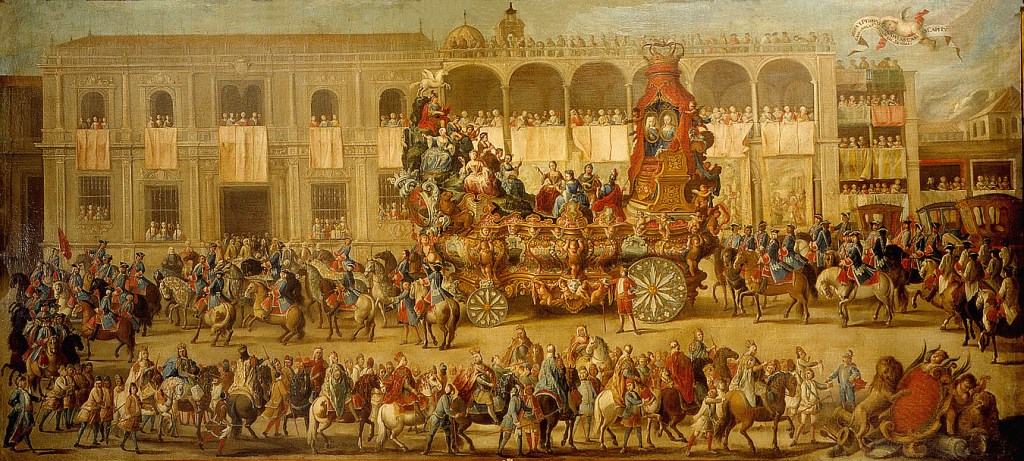
From the edition of a book that collected and dated the oldest Autos of Spain, it is believed that they were represented for the first time between 1550 and 1570. Of the 96 pieces collected in this book entitled: Collection of farcical Autos and dialogs of the sixteenth century (better known as Codex of Old Autos) there are more than thirty with themes of the Sacrament of the Eucharist, so they could also be written for the celebration of the Corpus.
The enormous success of the Autos, the most religious and difficult to understand plays must have been because they were short: an act could not have more than 1000 verses (normal comedies had more than 3000). They were also accompanied by Loas (praises), Entremeses, Jácaras, Mojigangas and processions with Tarascas: the religious was mixed with the profane to not bore the ordinary people.
It must have been so successful that the City Councils in search of greater eloquence and prestige (like what happens now with Christmas lighting) decided to invest more and more. And of course, the money attracted the attention of the most important companies (title companies) and the most sought-after authors, with, it could not be otherwise, Lope de Vega in the lead. During the celebration of Corpus Christi of Seville of 1604 one of the Autos that was included in El Peregrino en su Patria (The Pilgrim in his Homeland), was performed; this is considered the first performance of which we know the date and documentation of the contracts.
After this, almost all reputable authors started writing Autos Sacramentales, with José de Valdivieso, Mira de Amescua and Tirso de Molina as the highlights. But Calderón de la Barca took it to the summit of perfection. He premiered the first Auto in Madrid in 1634 and continued to produce this genre until the day of his death in 1680.
But talking about this would be another topic, since what we want to note is how this day became so important for the theatrical world in that Spain.
First it must be said that as the companies did not depend on the tickets sold for the day for their income. Instead, the municipalities hired them while making a good buck out of it. They used the extra money to restyle themselves: their costumes were refurbished, and increasingly extravagant. It was nice that the costumes could be used during the rest of the year, for the comedies because the authors used characters that could be archetypes of comedy: God was a Hero, The Soul was a Lady, the Devil could be a ‘comic servant’, etc.
It is also noteworthy that, because during Lent it was forbidden to perform, and that gave the producers an opportunity to contract new and more famous actors (the ‘contracts of Lent’), with ‘items’ in those contracts that promised these famous actors that they were going to be paid extra from the money to be earned during the Corpus Christi period.
The only thing was that this only entailed one performance for the whole year, so they had to look for tricks to earn more. For example, originally only one Auto was performed, in the afternoon, but later, starting in Madrid, two began to be performed: one in the morning in the middle of the procession and another in the afternoon. Other municipalities did not take long to follow this example. Although the town halls forbade that the actors of the morning were the same as of the afternoon, to avoid that the one who represented God in the morning perhaps in the afternoon was the Pleasure or the Devil, or the Virgin of the Morning was the Guilt of the afternoon thereby confusing the simplest spectators.
Therefore, the municipalities hired two different companies. but because every law has a loophole, this obstacle could be solved in a different way: Because the companies were often composed of between fifteen and twenty actors, the producers asked the playwrights to write Autos with only eight characters in them, so that half of the company represented in the morning and the other half in the afternoon. There is a documented case with Lope de Vega who wrote two Autos with few actors to be represented on the same day by the company of the producer Antonio de Riquelme, during the Corpus of Toledo of 1615.
Another solution was that two companies agreed to perform in one place in the morning and in another during the afternoon; of course, those had to be nearby sites to not lose the second contract. This is exemplified very well by Cervantes in Don Quixote, when the Nobleman and Sancho run into the wagon of the Author Angulo el Malo while the actors are dressed as their theatre characters (the Devil, an Angel, a Queen, the Cupido, etc.) so that Don Quixote believes that they really are the creatures as shown by their cloths, and he starts to challenge them. But then he lets them go because, because the Devil explains him that in order not to waste time, having finished performing an Auto in one town they go to another city in which they will start without having to change:
Lord, we are reciters of the company of Angulus the Bad. We have done in a place that is behind that hill, this morning, which is the eighth of the Corpus, the Auto of the Courts of Death, and we have to do this afternoon in that place that from here resembles; and for being so close and scrutinizing the work of undressing and dressing again, we leave dressed in the same dresses we represent[2].
Finally, as the Devil says to Don Quixote, the Octave of Corpus also began to be celebrated, the Thursday following the day of the official celebration and, of course, this also led to two other Autos in all places. Large cities, towns, villages, and one-horse towns celebrated their Corpus now with four Autos.
Because the contracts were financially good, because they could renovate the costumes, because they could hire more famous actors for the whole coming season, because they could cash in from four Autos instead of one, and because they could hire better playwrights (who also gave the genre higher quality) for all that reasons; all, all the companies, even the poorest ones, like the Companies of La Legua, waited for the day of Corpus Christi like a Godsent, almost it determined the rest of the season.
Dear reader, I hope that this season of the Comedians’ Goat that is now going on vacation, you liked it. See you, if you want to keep reading, in September.
[1] This had already been realized in the Athens of Pericles, because the theater had been born to illustrate about the gods in the Tragedies and in the Satirical Dramas and had turned towards political satire with the Comedy – if not, ask Aristophanes and even Pericles himself – what happens is that in the Spanish theatrical context, that began to acquire preponderance, an attempt was made to make a commercial theatre, «that would please the vulgar», as Lope de Vega said in his New Art of Making Comedies. However, the Autos Sacramentales wanted to have another purpose and that was what made them a very peculiar genre.
[2] Chapter XI of the second part of Ingenious Hidalgo Don Quixote de la Mancha by Miguel de Cervantes.


Esta vez, me ha sabido a poco, seguro que nos esperan más sabias confidencias en septiembre, como experto que eres en estos Autos.
Buenas vacaciones
Me gustaMe gusta