Hola amigos de nortonteatro.blog, yo soy Nortan Palacio, conocido artísticamente y en Flandes, como Norton P.
Hello friends of nortonteatro.blog, I am Nortan Palacio, known artistically, and in Flanders, as Norton P.
Viernes 22 de septiembre 2023.
ENGLISH VERSION: BELOW THE SPANISH VERSION
ANÉCDOTA 83
LOS SEGUNDONES EN EL TEATRO DEL SIGLO DE ORO ESPAÑOL: ANDRÉS DE CLARAMONTE.
Si no fuera porque en el libro El viaje entretenido[1] de Agustín de Rojas Villandrando aparecía mencionado Andrés de Claramonte como “uno de los farsantes que han hecho farsas, loas, bailes y letras” este nombre quizá nos estaría vedado de la lista de actores y dramaturgos que dio el citado Siglo de Oro español y habría estado en esa lista que comentábamos al inicio de la temporada que recoge, sin nombrarlos, más de 1000 autores de la época que escribían teatro para los Corrales de Comedias[2].
Pero aunque Agustín de Rojas lo salvó del anonimato, no lo hizo de la mala consideración que los críticos han tenido hasta hace muy poco de Claramonte, y digo hasta hace muy poco (segunda mitad del siglo XX), porque de un tiempo a esta parte se han venido produciendo estudios e investigaciones que, ¡oh sorpresa!, le atribuyen a nuestro dramaturgo la autoría de algunas de las más grandes obras de aquella época; como son la popularísima ‒y alabada como magistral‒ comedia, siempre atribuida a Lope de Vega: La estrella de Sevilla, y, además ‒y si esto es verdad que la historia nos perdone‒ la creación de uno de los Mitos literario-dramáticos más grandes de la Literatura Universal (con mayúsculas) y que no es otro que el Don Juan Tenorio del Burlador de Sevilla, autoría que ahora Claramonte disputa con Tirso de Molina, con grandes visos de coronarse ganador de la contienda.
Y si esto no fuera poco, un Auto Sacramental titulado La Araucana, que en los últimos años ha despertado gran curiosidad de los críticos por ser el único que hace un paralelismo entre la figura de Jesucristo y un personaje indígena de la conquista de América: el cacique araucano Capoulican, y que es una pieza que de siempre se había atribuido a Lope de Vega por ser muy cercano a su comedia El Arauco domado, ahora resulta que al parecer es de Andrés de Claramonte[3]. Y así, con algunas otras obras que luego veremos.
Si la semana pasada decíamos que Guillen de Castro es un autor en alza, pues de Andrés de Claramonte habrá que decir que ya está alzado. Lástima que como estos estudios son de hace relativamente poco, por su trayectoria vital no se había preocupado casi nadie y los datos de su biografía, comparando con otros de su época, son pocos. Aun así vamos a intentar conocer los más llamativos para el Mentidero de los Comediantes.
Andrés de Claramonte y Corroy nació en Murcia en unas fechas cercanas a1580, hasta hace poco se decía que podría haber nacido en Sevilla, pero ahora parece que ya hay más datos que dan por hecho que nació en Murcia. Tampoco se sabe muy bien quienes fueron sus padres; lo que nos dice el Diccionario Biográfico de la Real Academia Española de la Historia es que quizá fue hijo de un zapatero llamado Pedro de Claramonte avecindado en Murcia en 1577. Murió relativamente joven en septiembre de 1626 en Madrid. Lo dicho: muy poco se sabe de su vida personal.
Una de las cosas que podemos entrever cuando examinamos su carrera teatral es que era ambicioso, puesto que todo lo logró en poco tiempo: La primera vez que es nombrado como gente que se dedica al teatro es como dije en El viaje entretenido, que se editó en 1603; está documentado que en 1604 trabajaba como actor en la Compañía de Baltasar de Pinedo y en 1605 en la Compañía de Antonio Granados, para este tiempo ya se había casado con Beatriz de Castro Virués ‒mujer de apellidos notables‒y en 1607 había formado su propia compañía, puesto que se han encontrado contratos de la época que nos dicen que la Compañía de Andrés de Claramonte contrata representaciones en la ciudad de Toledo y en los años sucesivos hay contratos con las ciudades de Valencia, Murcia, Madrid y Córdoba.
En 1614 su compañía fue nombrada por el Rey Felipe III como «Compañía Real o de Título» una categoría que era muy difícil de alcanzar, ya que solo se otorgaba a pocas compañías (doce en ese año) que se aseguraban poder actuar en la corte y en todas las grandes ciudades sin restricción ninguna.
Como dramaturgo, su primera obra conocida es La católica Princesa Leopolda de 1613, aunque debió haber escrito antes algunas más, puesto que un documento de 1615 dice que se obliga a Andrés de Claramonte a entregar a una compañía cuarenta comedias o más.
En su estilo sigue a Lope de Vega en la estructura, como por ejemplo la ruptura de las unidades dramáticas y la mezcla de lo cómico y lo trágico, aunque se aleja de él en el gusto por lo sobrenatural y lo milagroso; en que los finales son insólitos (no los típicos matrimonios entre los protagonistas) y que se desarrollan en espacios majestuosos (escenografías espectaculares). Por todo esto hay momentos en que sus obras tienen escenas inverosímiles y contradictorias, buscando agradar al público, pero despreocupándose del lenguaje y del estilo.
Todo esto hizo que su reputación como escritor no fuera valorada, y que por lo tanto, se cree que sus mejores obras se le atribuían a otros autores más reputados; que por otro lado era una cosa bastante usual en su época: si una obra era buena debía ser de Lope o de Tirso (para la época de Claramonte todavía Calderón no era conocido).
Entre las obras que se disputa con Lope de Vega, además de la mencionada La estrella de Sevilla, están: El inobediente o la ciudad sin Dios; El honrado con su sangre, Pusóseme el sol salióme la luna y Dineros son Calidad. Se creé que Claramonte, al trabajar con las mencionadas compañías de Pinedo y de Granados que eran dos compañías a las que Lope proporcionaba más obras, de tanto actuar en ellas y de aprenderse de memoria tantos de sus versos, adquiriría un estilo, como dijimos, cercano al de este; y por eso si realmente escribió esas obras se podrían percibir como escritas por el gran Lope de Vega.
En cuanto a la atribución de El burlador de Sevilla y El condenado por desconfiado de Tirso de Molina, se debe a que en muchas obras, que sí que son de Claramonte (se sabe porque son manuscritos de su puño y letra) se aprecian situaciones y personajes que van configurando la gran obra que tiene entre sus personajes al Comendador o convidado de piedra y al mito de Don Juan; como son: la mencionada La católica princesa, El Rey don Pedro en Madrid o De esta agua no beberé.
De cualquier manera, Tirso tuvo muchos defensores de su autoría en importantes investigadores de varios siglos como Hartzenbush, Menéndez Pelayo, Cotarelo y Mori y, últimamente, en Blanca de los Ríos y por eso casi nadie dudaba de que el Burlador fuese de su autoría. Y, como dije, hasta hace relativamente poco Claramonte ha empezado a tener sus propios defensores sobre todo después de los valientes trabajos de Alfredo López-Vázquez, Fernando Cantalapiedra, Gerald E. Wadde o Charles v. Ganellin.
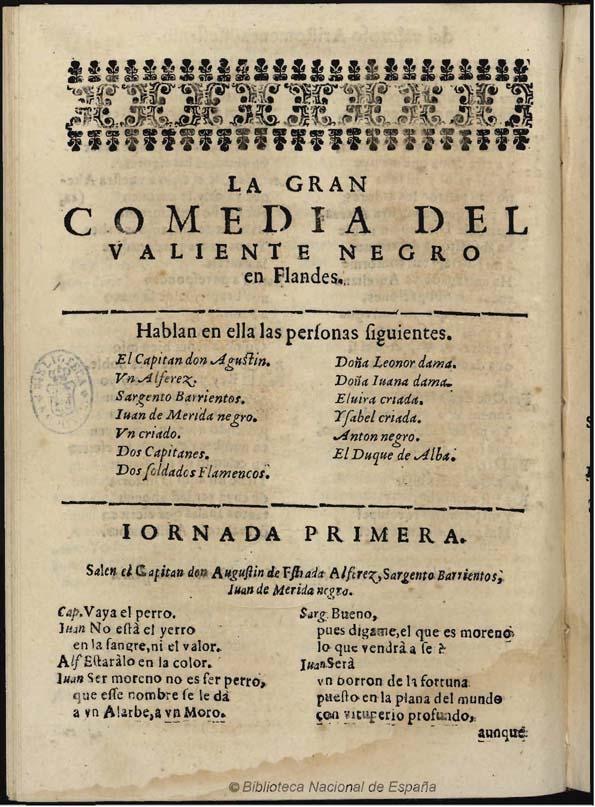
De las obras de Claramonte de las que no se tiene dudas autoriales, además de las mencionadas, podemos resaltar El nuevo Rey Gallinato, El secreto en la mujer, La infelice Dorotea y una obra que últimamente está ganando puntos para ser considerada obra maestra: El valiente negro en Flandes; por ser una obra que refleja el racismo desde una particularidad muy avanzada para aquel momento: donde un esclavo negro, Juan de Mérida, al ganar su libertad se alista en el ejército y llega a ser declarado héroe, a las ordenes del Duque de Alba, en la guerra contra los Países Bajos y que, además de subir todos los peldaños en el escalafón militar, al final contrae matrimonio con su antigua dueña; quien se enamora de la valentía y el honor de su esclavo, y es ella, personaje atípico en este tipo de comedias, quien le pide matrimonio. Que alguien diga si no es un asunto adelantado para su época.
Esperando ver si este segundón algún día llega la primera línea de entre los dramaturgos contemporáneos a él, me despido hasta la próxima semana.
[1] En las anécdotas 15 y 16 de este blog, hicimos una revisión de este libro y en ellas también mencionamos que gracias a esto se salvó Claramonte del anonimato.
[2] En la entrada de hace dos semanas decíamos que un estudio realizado por Héctor Urzaiz reveló que había habido más de 1107 dramaturgos en aquella época.
[3] El día que en un congreso sobre Autos Sacramentales escuché esta afirmación, no pude dejar de reír y comentar con mi vecino de butaca, el catedrático Rafael González Cañal, que si era habitual decir la famosa muletilla: «en el siglo XVII todo lo buenos era de Lope», ahora habría que cambiar el destinatario y decir que «todo lo bueno es de Claramonte»
ANECDOTE 83
LOS SEGUNDONES (SECONDS) IN THE TEATRO OF THE SPANISH GOLDEN AGE: ANDRÉS DE CLARAMONTE.
If it were not for Andrés de Claramonte was mentioned as «one of the comedians who made farces, praises, dances and lyrics» in Agustín de Rojas Villandrando’s book, El viaje entretenido[1], his name would probably never have reached the list of actors and playwrights produced by the Spanish Golden Age. Instead, his name would be in the list that I mentioned at the beginning of the present season, that describes, without naming them, more than 1000 authors of the time who wrote theatre for the Corrales de Comedias[2].
But although Agustín de Rojas saved him from anonymity, he did not do so from the negative views that critics had about Claramonte until very recently. I can even say until very recently (second half of the twentieth century), because for some time now studies and investigations have been produced that, oh surprise(!), attribute to our playwright the authorship of some of the greatest works of that time; such as the very popular ‒and praised as masterful‒ comedy, that was always attributed to Lope de Vega: The star of Seville. In addition ‒and when this is true, that history forgives us‒ the creation of one of the greatest literary-dramatic myths of World Literature (with capital letters) which is none other than Don Juan Tenorio del Burlador de Sevilla, of which the authorship of Claramonte now is disputed with Tirso de Molina, and with all signs of him being crowned as the winner of the contest.
And as if this were not enough, an Auto Sacramental entitled La Araucana, which in recent years has aroused great curiosity from critics for being the only one that draws a parallel between the figure of Jesus Christ and an Indigenous character of the conquest of America: The Araucan cacique Capoulican. That play had always been attributed to Lope de Vega for being very akin to his comedy El Arauco domado. But now it turns out that the work it apparently is from Andrés de Claramonte[3]. And it continues this way with several other works.
When last week we said that Guillen de Castro is an author on the rise, then about Andrés de Claramonte I will have to say that he already has been raised. It is a pity that because these studies are relatively recent, almost no one was interested in his life and the data on his biography are few when comparing with other writers of his time. Even so, we will try to know the most striking things for the Comedians’ Mentidero.
Andrés de Claramonte y Corroy was born in Murcia around 1580. Until recently it was said that he could have been born in Sevilla, but now there is more information that assumes that he was born in Murcia. Neither is it very well known who his parents were. The Biographical Dictionary of the Spanish Royal Academy of History tells us is that he maybe was the son of a shoemaker named Pedro de Claramonte who settled in Murcia in 1577. He died relatively young in September 1626 in Madrid. Further very little is known about his personal life.
One of the things we can glimpse when we examine his theatrical career is that he was ambitious, since he achieved everything in a brief period. The first time he is named as someone who dedicated themselves to the theatre is, as I said, in El viaje entretenido, which was published in 1603. It has been documented that in 1604 he worked as an actor in the Company of Baltasar de Pinedo and in 1605 in the Company of Antonio Granados. By that time he had already married Beatriz de Castro Virués –a woman of notable surnames– and in 1607 he had formed his own company, which is known from contracts of that time that were found and tell us that the Company of Andrés de Claramonte hires performances in the city of Toledo and about the following years there are contracts with the cities of Valencia, Murcia, Madrid and Córdoba.
In 1614 King Philip III named his company ‘Royal Company’ a category that was exceedingly difficult to achieve, since this honour was only granted to a few companies (twelve in that year) that were then assured to be allowed to act at court and in all large cities, and without any restriction.
As a playwright his first known play is The Catholic Princess Leopolda of 1613, although he must have written some more before, since a document of 1615 says that Andrés de Claramonte is obliged to deliver forty comedies or more to a company.
In his style he follows the structure of Lope de Vega, such as the rupture of the dramatic units and the mixture of the comic and the tragic. However, he moves away from Lope in the taste for the supernatural and the miraculous. His endings are unusual (not the typical marriages between the protagonists) and they take place in majestic spaces (spectacular decors). For all this there are moments in which his works have implausible and contradictory scenes, seeking to please the public, and not worrying about language and style.
All this meant that his reputation as a writer was not valued, and therefore, it is believed that his best works were attributed to other, more reputable authors. This was a fairly usual thing in this time: if a work was to be considered good it should have been written by Lope or Tirso (Calderón was still unknown in the time of Claramonte).
Among the works that are disputed being written by Lope de Vega, in addition to the aforementioned The Star of Seville, are: El inobediente o la ciudad sin Dios (The disobedient or the city without God); El honrado con su sangre (The honoured with his blood), Púsoseme el sol, saliome la luna, (The sun subsides, the moon comes up) and Dineros son calidad (Money is quality). It was thought that Claramonte, by working in the companies of Pinedo and Granados, two companies to which Lope provided many works, and from so much acting with them and learning so many of his verses by heart, he could have acquired a style close to that of Lope. That is why, if he really wrote those works, they could be perceived as written by the great Lope de Vega.
As for the attribution of El burlador de Sevilla and El condenado por desconfiado to Claramonte or Tirso de Molina, it is due to the fact that in many works, which definitely are from Claramonte (this is known because there are manuscripts in his own handwriting) many situations and characters are recognized that form the great work that has among its characters the Comendador, the guest of stone, and for the myth of Don Juan such obras as the The Catholic Princess, King Don Pedro in Madrid or De esta agua no beberé.
In any case, Tirso had many defenders of his authorship from important researchers of several centuries such as Hartzenbush, Menéndez Pelayo, Cotarelo and Mori and lately in Blanca de los Ríos. That is why almost nobody doubted that El burlador de Sevilla is of his authorship. And, as I said, until relatively recently Claramonte has begun to have his own defenders especially after the courageous writings of Alfredo López-Vázquez, Fernando Cantalapiedra, Gerald E. Wadde or Charles v. Ganellin.
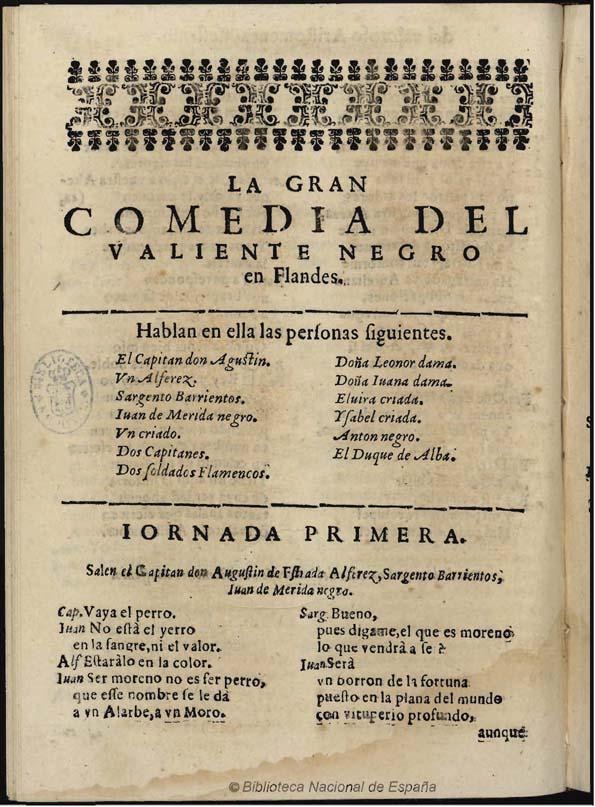
Of the works of Claramonte of which there are no authorial doubts, in addition to those mentioned, we can highlight El nuevo Rey Gallinato (The new King Gallinato), El secreto en la mujer (The secret in the woman), La infelice Dorotea (The unhappy Dorothea)and a work that lately is gaining points to be considered a masterpiece: El valiente negro en Flandes (The brave black in Flanders),for being a work that reflects on racism from a very advanced standpoint for that moment: A black slave, Juan de Merida, upon winning his freedom enlists in the army and under the orders of the Duke of Alba, in the war against the Netherlands was declared a hero. In addition to climbing all the steps in the military ladder, in the end he marries his former owner, who falls in love with the courage and honour of her slave. It is she, a unique character in this type of comedies, who asks him to marry her. Let´s agree that this is a topic that was way ahead of its time.
Hoping to see if this seconded one day comes to the forefront among contemporary playwrights, I say goodbye until next week.
[1] In anecdotes 15 and 16 of this blog, we reviewed this book and in them we also mentioned that thanks to this Claramonte was saved from anonymity.
[2] In the post two weeks ago I said that a study conducted by Héctor Urzaiz revealed that there had been more than 1107 playwrights at that time.
[3] The day that in a congress about Autos Sacramentales I heard this statement, I could not stop laughing and commenting to the man next to me, Professor Rafael González Cañal, that if it was usual to say the famous phrase: «in the seventeenth century everything good was Lope», now we would have to change the recipient and say that «everything good is from Claramonte».
 Norton Teatro
Gracias Norton por acercarnos cada semana a autor@s casi desconocidos por el gran público (segundones) y descubrirnos tantos grandes dramaturgos y obras a quienes amamos el teatro del siglo de oro.
Me gustaMe gusta