
Hola amigos de nortonteatro.blog, yo soy Nortan Palacio, conocido artísticamente y en la Academia de los Nocturnos como Norton P.
Hello friends of nortonteatro.blog, I am Nortan Palacio known artistically and in the Academy of the Nocturnes as Norton P.
Viernes 16 septiembre 2023
ENGLISH VERSION: BELOW SPANISH VERSION
ANÉCDOTA 82
LOS DRAMATURGOS SEGUNDONES: GUILLEN DE CASTRO Y BELLVÍS
Como prometía en la presentación de la temporada de otoño del Mentidero de los Comediantes, aquí van mis anécdotas sobre los dramaturgos llamados segundones. En esa presentación decía que eran «mal llamados segundones» y me reitero en mi apreciación, porque documentándome en las biografías de estos hombres, cada vez descubro más razones para creer que en su época fueron bastante reconocidos y no solo en España sino en Europa y en la, entonces, América colonial.
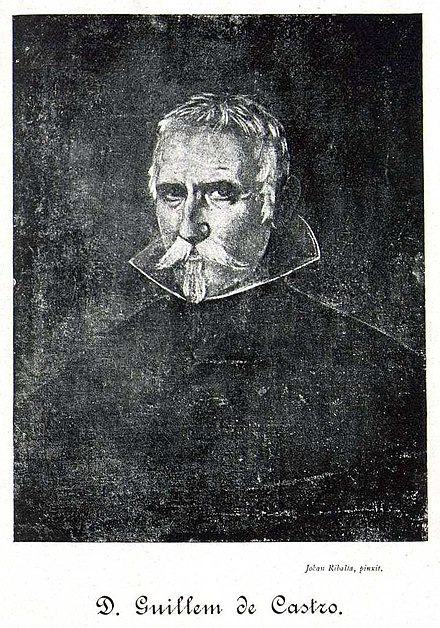
El primero sobre el que voy a tratar es Guillen (o Guillem) de Castro, puesto que actualmente en algunos círculos literarios y teatrales es considerado casi como uno de los autores de primera línea (mayorazgos)[1], además de que, como dicen Félix Blanco e Irene Escudero en su artículo Segundones o la recuperación del patrimonio textual: es un autor que está en alza.
Pero es que, leyendo algunas de sus biografías[2], descubro que fue un autor muy reconocido en su época en Europa y que fue valorado por autores como Shakespeare en Inglaterra y por Pierre Corneille en Francia, quienes incluso lo copiaron, como luego veremos.
Guillen de Castro nació en Valencia el 4 de noviembre de 1569 y murió en Madrid el 28 de julio de 1631, es decir que tenía 62 años, y como signo de la paradoja de su época vale decir que nació en cuna noble y murió tan pobre que se dice lo enterraron de limosna en el hospital de la Corona de Aragón. Pero tuvo una vida bastante plena y aquí la vamos a descubrir.
Se dice que por parte de madre (Castellana Bellvís) sus ancestros se remontaban al rey Juan I de Aragón y que su abuelo paterno (Beltrán de Castro) había obtenido «privilegio de nobleza» de manos del emperador Carlos I en recompensa por servicios prestados en la campaña de las Indias, por lo que su padre (Francisco de Castro Palafox) ostentaba título de «Ilustre Cavaller».
De hecho, Guillem se dio a conocer como escritor, con 21 años, en una conocida justa poética que se celebró con motivo de los esponsales de uno de sus ilustres familiares: Francisco Palafox, Señor de Ariza, que contrajo nupcias con Lucrecia de Moncada.
La celebración de dicho matrimonio y de la justa poética fueron tan famosas en la Valencia de la época que fueron asunto de una comedia llamada El prado de Valencia, compuesta por Francisco Agustín de Tárrega (canónigo Tárrega), el más famoso autor de comedias de ese entonces y de quién se dice que Lope de Vega tomó mucho para crear su metodología teatral.
Entonces a Guillem se le permitió entrar en la famosa Academia de los Nocturnos de Valencia en 1593 y se le bautizó con el seudónimo de «Secreto[3]». En este ambiente conoció a dramaturgos como el mencionado Canónigo Tárrega, a Andrés de Artieda, Cristóbal de Virués, Miguel Beneyto y otros a los que se les consideraba el Grupo de Valencianos que habían revolucionado la escritura dramática y que, como yo apuntaba, habían influido en la creación de la formula teatral (Comedia Nueva) de Lope de Vega, quien había vivido en Valencia durante su exilio. Así se inició Guillem de Castro en la escritura dramática y de hecho sus dos primeras comedias las publicó en un volumen conjunto con varios miembros de dicha Academia.
Aunque también se dedicaba a las armas, como muchos de los escritores de la época, y así desempeñó cargos como Capitán de caballería de la costa del Reino de Valencia entre 1593 y 1600, como Procurador general al servicio de Carlos de Borja, Duque de Gandía en 1601, o en Italia adonde había llegado sirviendo al entonces Virrey de Nápoles Juan alonso Pimentel de Herrera entre 1605 y1609 y adonde llegó a ostentar el título de Gobernador de Scigliano.
No se sabe por qué regresó a Valencia, pero no debe haber sido algo agradable puesto que se sabe que regresó muy pobre y para colmo contrajo una enfermedad que lo tuvo convaleciente más de tres años.
En mitad de todo esto se había casado dos veces, la primera en 1593 con Helena Fenollar de la que se divorció se ve con no muy buenos recuerdos, porque en varias de sus obras teatrales se retrata el matrimonio como una carga pesada y el divorcio como una liberación. La segunda vez, en 1595, se casó con Marquesa Girón de Rebolledo, que con su dote alivió las penurias que Guillen estaba pasando en ese momento, tuvieron una hija, pero ambas murieron pronto.
En 1619 se marchó a Madrid y allí con ayuda del del Conde Duque de Olivares entró a servir como secretario a Juan Téllez-Girón, Marqués de Peñafiel; con ayuda de Lope de Vega empezó a vender sus comedias al empresario Antonio de Prado y hasta fue nombrado Caballero de la Orden de Santiago en 1623; no le iba nada mal, pero al parecer tenía muy mal carácter, era obstinado, altivo y clasista (quizá por su noble cuna), esto hizo que se le cerraran muchas puertas y volvió a los tiempos de pobreza. Además nunca pudo colgarse el hábito de Santiago, puesto que en 1624 fue involucrado en la muerte de un caballerizo del nuncio apostólico de Madrid y, aunque fue absuelto, el escándalo le persiguió y no se le permitió vestirse de Caballero de la tal orden.
Pero misteriosamente en 1625 se casó con una joven treinta años menor que él que era también noble, aunque, esta sí, rica. Y decimos que misteriosamente, puesto que asombra que hubiera concertado tal matrimonio, ya que que en muchas de sus comedias se encargaba de satirizar los matrimonios desiguales entre hombres maduros (ricos) y jovencitas (pobres): aunque en su caso el asunto del dinero era el contrario. Con la dote de su joven esposa podría vivir bien sus últimos años, aunque debió malbaratarla puesto que se sabe que murió seis años después en la pobreza más absoluta.
En cuanto a su obra dramática cabe señalar que copió mucho y fue bastante copiado, aunque en sus «copias» siempre añadía novedades que lo singularizaban y lo alejaban de ser el típico seguidor de la comedia lopesca.
En tres de sus comedias rehízo novelas cortas de Miguel de Cervantes: dos de ellas las que tituló El curioso impertinente y la homónima Don Quijote de la Mancha, tratan temas de novelas insertas en el real Don Quijote de Cervantes. En la primera toma la misma novela del Curioso impertinente pero amplía los antecedentes y añade complejidad psicológica a los personajes, además cambia el final para que los amantes terminen juntos, después de la trágica muerte del antagonista; justicia poética.
En Don Quijote de La Mancha, toma el tema de los amores de Cardenio, Lucinda, Fernando y Dorotea, personajes de otra novela (vivida y no narrada) inserta en el Quijote Cervantino; allí los protagonistas son los mencionados amantes y Don Quijote y Sancho Panza aparecen caracterizados como fantoches más propios de personajes de entremés. Sin embargo esto debió gustar mucho en Europa[4], puesto que se dice que para su obra Historia del loco Cardenio[5], William Shakespeare tomo como referente al Cardenio dibujado por Guillem de Castro en lugar del original cervantino. Guillem también rehízo para el teatro la novela ejemplar (esta sí de las reales novelas ejemplares, no intercalada, de Cervantes) La fuerza de la sangre.
En cuanto a sus comedias de costumbres caben destacar Los malcasados de Valencia, una de sus mejores obra y donde critica el sacramento matrimonial con ahínco, pero además deja ver su singularidad con la estructura de la trama que termina en doble divorcio en lugar de los típicos finales de la comedia lopesca con dobles matrimonios, además recrea una escena de amor que a ojos de los otros personajes de la obra es una relación homosexual y los personajes tienen que tomar partido acerca de si está bien o mal, un asunto muy controvertido para el teatro de la época.
También es importante la comedia El Narciso en su opinión, porque se considera que en esta obra Guillem creó el precedente de un personaje que daría pie a un tipo propio de comedia, es el personaje del Figurón (así llamado por lo ridículo que los otros lo ven y lo bien vestido y educado que él mismo se cree) que después se convertiría en un tipo favorito del público y es de aquí de donde Agustín Moreto tomaría la inspiración para su Lindo don Diego, la comedia de figurón por excelencia.
Finalmente, tomaba Guillem de Castro asuntos del romancero español y de allí tomo el tema para dos de sus más grandes obras: El conde Alarcos y Las mocedades del Cid, tomados de los romances épicos castellanos. La vida del Cid no la que se narra en el famoso poema épico, sino antes de llegar a ser el héroe más celebrado de la historia de España. De las Mocedades del Cid de Guillem de Castro se valió el tragediógrafo francés por antonomasia Pierre Corneille para crear su famosísima Le Cid, que fue una obra que marcó la poética teatral de toda la Europa del siglo XVIII.
Para que luego digan que no es «mal llamado: segundón»
Nos vemos la próxima semana.
[1] Como llama Ignacio Arellano a los autores de primera fila: comenzando por la «trinidad» formada por Lope de Vega, Tirso de Molina y Calderón de la Barca, y en menor medida: Francisco de Rojas Zorrilla, Miguel de Cervantes y Juan Ruíz de Alarcón.
[2] La más documentada es la de Joan Oleza Simó, de la Universidad de Valencia
[3] Entrar en dicha Academia era bastante difícil y cada miembro de la academia tenía que ponerse un seudónimo que fuera una calificación metafórica de la Noche, así: Silencio, Sombra, Tinieblas, Vigilia o Secreto
[4] Existe documentación donde se da cuenta de que en principio en Europa se tomó a los personajes de Don Quijote y Sancho como personajes folclóricos, cómicos e incluso chabacano, hubo que esperar a los románticos alemanes para que llegara a entenderse su profundidad sicológica. Puede consultarse la bibliografía que nos ofrece a este respecto Carlos Cabanillas en su artículo: La popularización de Don quijote en el siglo XVII
[5] Historia del loco Cardenio es una obra teatral perdida de Shakespeare, de la que se sabe su segura existencia porque se representó dos veces por la compañía King´s Men en 1613 y por una reconstrucción sobre fragmentos de la obra conservados, que realizó el experto en Shakespeare Gary Taylor en 2007.
ANECDOTE 82
THE SECONDERS PLAYWRIGHTS: GUILLEN DE CASTRO AND BELLVÍS
As I promised in the presentation of the fall season of the Comedians’ place for gossips (Mentidero de los Comediantes), here are my anecdotes about the playwrights called ‘seconds’. In that presentation I said that they were misnamed ‘segundones’ (‘seconders’) and I reiterate my appreciation, because documenting myself on the biographies of these men, I discover more and more reasons to believe that in their time they were quite recognized and not only in Spain but in Europe and in the then colonial America.
The first one I am going to deal with is Guillen (or Guillem) de Castro, since in some literary and theatrical circles nowadays he is considered, by some, one of the authors of the first line (mayorazgos) [1], in addition to that, as Félix Blanco and Irene Escudero say in their article ‘Segundones o la recuperación del patrimonio textual’: he is an author who is on the rise.
But it was from reading some of his biographies[2], that I discovered that he was a well-known author in his time in Europe and, as we will see later, that he was valued by authors such as Shakespeare in England and by Pierre Corneille in France, who even copied him.
Guillen de Castro was born in Valencia on November 4, 1569, and he died in Madrid on July 28, 1631, aged 62. As a sign of the paradox of his time it is worth saying that he was born in a noble cradle and he died so poor that it is said that he was burial was paid with alms from the hospital of the Crown of Aragon. But he had quite a full life, which we are going to discover here.
It is said that on his mother’s side (Castellana Bellvís) his ancestors went back to King Juan I of Aragon, and that his paternal grandfather (Beltrán de Castro) had obtained ‘privilege of nobility’ from the hands of Emperor Carlos I as a reward for services rendered in the campaign of the Indies, for which his father (Francisco de Castro Palafox) held the title of ‘Illustrious Knight’.
In fact, Guillem became known as a writer, at 21 years, in a well-known poetic fair that was celebrated for the occasion of the engagement of one of his illustrious relatives: Francisco Palafox, Lord of Ariza, who married Lucrecia de Moncada.
The celebration of this marriage and the poetic fair were so famous in Valencia at that time that they became the subject of a comedy called ‘El prado de Valencia’, composed by Francisco Agustín de Tárrega (dean Tárrega), the most famous author of comedies of that time, and of whom it is said that Lope de Vega borrwed a lot to create his theatrical methodology.
Guillem was then allowed to enter the famous Academy of Nocturnes of Valencia in 1593 and was baptized with the pseudonym of ‘Secret’[3]. In this environment he met playwrights such as the aforementioned dean Tárrega, Andrés de Artieda, Cristóbal de Virués, Miguel Beneyto and others who were the Group of Valencians who had revolutionized dramatic writing and who, as I pointed out earlier, had influenced the creation of the theatrical formula (Comedia Nueva) of Lope de Vega, who had lived in Valencia during his exile. This is how Guillem de Castro began his writing of theatre plays, and in fact his first two comedies were published in a joint volume with several members of the Academy.
He was also in the military, like many of the writers of that period, and thus, between 1593 and 1600, held positions like Captain of cavalry of the coast of the Kingdom of Valencia, and, in 1601, like Attorney General at the service of Carlos de Borja, Duke of Gandía, or in Italy, where he served the then Viceroy of Naples, Juan Alonso Pimentel de Herrera between 1605 and 1609 and, where he came to hold the title of Governor of Scigliano.
It is not clear why he returned to Valencia, but it must not have been something pleasant since it is known that he returned very poor, and to top it off, he contracted an illness that had him recovering for more than three years.
In the middle of all this he married twice, the first, in 1593, with Helena Fenollar from whom he divorced clearly with bad memories, because in several of his plays marriage is portrayed as a heavy burden, and divorce as a liberation. The second time, in 1595, he married Marquesa Girón de Rebolledo, who with her dowry alleviated the hardships that Guillen was going through at that time. They had a daughter, but both mother and daughter died soon.
In 1619 Guillen went to Madrid, and there with the help of the Count Duke of Olivares he started to serve Juan Téllez-Girón, Marquis of Peñafiel as secretary. And with the help of Lope de Vega he began to sell his comedies to the impresario Antonio de Prado, and he was even named Knight of the Order of Santiago in 1623. He was not doing badly, but apparently, he had a very nasty temperament, he was obstinate, arrogant and class conscious (perhaps because of his noble birth). This closed many doors for him, and in 1624, he returned to the state of poverty. In addition, he was forbidden to wear the habit of Santiago anymore because he had been involved in the death of a knight of the apostolic nuncio of Madrid, and, although he was acquitted, the scandal persecuted him, and he was not allowed to dress as a Knight of the order.
Mysteriously, in 1625, he married a young woman, thirty years younger than he, who was also from nobility and rich. I said mysteriously, because it is surprising that he could have arranged such a marriage, while, although in his case the issue of money was the opposite, in many of his comedies he had been satirizing unequal marriages between mature rich men and poor young girls. With the dowry of his young wife, he should have been able to live well his last years, but he must have spoiled it again since it is known that he died six years later in the most absolute poverty.
As for his dramatic work, it should be noted that he copied a lot and was copied a lot, although in his ‘copies’ he always added novelties that singled him out and distanced him from being the typical follower of the comedies of Lope de Vega.
In three of his comedies, he reused short novels by Miguel de Cervantes: two of them, entitled The Curious Impertinent and the same named Don Quixote de la Mancha, deal with themes of novels inserted in the real Don Quixote by Cervantes. In the first, he takes the same novel of the Curious impertinent but expands the background and adds psychological complexity to the characters, and he also changes the ending so that the lovers end up together, after the tragic death of the antagonist: Poetic justice.

In Don Quixote de La Mancha, he takes the theme of the love affairs of Cardenio, Lucinda, Fernando and Dorotea, characters from another novel (lived and not narrated) inserted in Cervantes’ Don Quixote. There the protagonists are the aforementioned lovers, while Don Quixote and Sancho Panza are characterized as clowns, which is more typical for characters of entremeses. This must have been very popular in Europe[4], since it is said that for his work Historia del loco Cardenio[5]. William Shakespeare took the Cardenio written by Guillem de Castro as a reference, instead of the original of Cervantes. For the theatre, Guillem also used The force of blood, the exemplary novel, of Cervantes, and not one of the novels interspersed in the middle of Don Quixote.
As for his comedies about customs of Spanish people, it is worth mentioning Los malcasados de Valencia, which is one of his best works. In it he criticizes the sacrament of marriage with zeal, and he also shows the unique structure of the plot that ends in a double divorce instead of the typical endings of the lopescan comedy with a double marriage. In this play Guillem also recreates a love scene that in the eyes of the other characters in the play, is a homosexual relationship. The characters must take sides about whether this is right or wrong, a very controversial issue for the theatre of that period.
The comedy El Narciso en su opinión, is also important becauseit is considered that in this work Guillem created the precedent of a character that would give rise to his own type of comedy. This is the character of the Figurón, so called because of how ridiculous the others think he is, while how well dressed and educated he himself believes he is. This character would later become a favourite type of the public, and also this is the comedy from which Agustín Moreto was going to take his inspiration for his comedy Lindo don Diego, the comedy of the figurón par excellence.
Finally, Guillem de Castro used the theme of the Spanish seductor, and with which he developed two of his greatest works: El conde Alarcos and Las mocedades del Cid, taken from the Castilian epic love stories. The life of El Cid is not the one narrated in the famous epic poem, but before he became the most celebrated hero in the history of Spain, Guillem de Castro’s Mocedades del Cid was used by the quintessential French playwright of tragedies Pierre Corneille to create his famous Le Cid, which was a work that marked the theatrical poetics of all eighteenth-century Europe.
So that later they say that it is not «bad to be called: seconders”.
See you next week.
[1] As Ignacio Arellano calls the authors of the first rank: starting with the «trinity» formed by Lope de Vega, Tirso de Molina and Calderón de la Barca, and to a lesser extent: Francisco de Rojas Zorrilla, Miguel de Cervantes and Juan Ruíz de Alarcón.
[2] The most documented biography of Guillem de Castro is the work of Joan Oleza Simó, from the University of Valencia
[3] Entering the Academy was quite difficult and each member of the academy had to put on a pseudonym that was a metaphorical qualification of the Night, like this: Silence, Shadow, Darkness, Vigil or Secret.
[4] There is documentation in which it is said that, in principle, in Europe the characters of Don Quixote and Sancho were taken as folkloric, comic and even shabby characters. It was necessary to wait for the German romantics to understand their psychological depth. You can consult the bibliography that Carlos Cabanillas offers us in this regard in his article: The popularization of Don Quixote in the seventeenth century.
[5] History of the Madman Cardenio is a lost play by Shakespeare, of which its existence is certain because it was performed twice by the King’s Men company in 1613 and by a reconstruction on fragments of the play preserved, made by the expert on Shakespeare Gary Taylor in 2007.
 Norton Teatro